Wednesday, November 17, 2010

Mirror: Enemy of the Good

By I.J. Hudson:

I looked into the mirror and what I saw scared me to death – well, almost.

It was one of those Bed, Bath & Beyond moments.  My wife had talked me into picking up a few things at the store. While she’s piling up stuff in a cart, I’m distracted by one of those two-sided “make-up mirrors.”  On one side, the lighted, regular view, but flip it over, and -- ALL, and yes, I mean ALL of your imperfections are magnified.  Whoaa!!  Trust me, it’s not a pretty sight if you’re over eight.

That got me to thinking.  (I apologize in advance.)  If we look too closely at ourselves, at what we’re trying to do, if we go “too granular” on things, we may ascribe too much value to the small imperfections seen only on our close-up instead of the really good stuff we see in the normal view.

Everyone can find something wrong if they look under the magnifying glass.  If we look closely enough, we can always improve.  IMHO, looking at the “close-up” reveals faults that the rest of the world just isn’t going to see, and perfect anything is not an option for many of us - whether it’s our face, an idea, a business model or anything else.

The old quote is loosely, “don’t let the perfect become the enemy of the good.” 
The lesson:  move forward with the good stuff;  the perfect rarely comes.  

And, in my case, (looking into the magnification mirror) the perfect is about 100 light years around the corner.

Sunday, November 14, 2010

Elements of a Great Presentation

By I.J. Hudson

Consider this a follow up to the “bad demonstration” posting a few days ago.

I saw a demonstration recently that justified all the hype about the newer phones that let your fingers do the selecting/shifting/expanding/moving/shrinking – whether it’s pictures or video.  In less than five minutes of pics/short videos we “met” a young member of our extended family.  The young tike lives in the UK, and until this demonstration we had heard about him and seen a few pictures – but really didn’t have a sense of who he was.  Now we do – thanks to the capabilities of the device, his dad’s familiarity with his new ‘Google phone’ and unbridled enthusiasm.

Let me be clear.  IMHO, successful presentations/demonstrations are a combination of three basic things.

     1. Quality of visuals
     2. How they’re presented – did things happen they way they should
     3. And mostly importantly, the way the person interacts with the audience – passion v. routine

I give a lot of weight to item number three because of an event about three years ago.  I sat next to the head of one of the tech councils in our area.  We always compared notes at these events and she showed me real wallet-sized pictures of her grandkids. She fanned out the pictures in her hand. Her pride came through loudly and clearly.  I was impressed.

They were great shots of her grandkids, and the overall personal “presentation” was awesome.  But if her presentation had it been coupled with the larger clearer photos/video displayed by an iPhone, Droid or other new touch-screen phone, it would have been even better.  (Maybe she’s using one today.) 

So, whether you’re showing off a grandkid, a newborn, or your company --- work on all three elements to make a truly effective presentation.  Have great pictures/videos to show your audience on the phone or iPad (or any of the other tablets coming out), know your device and practice, practice, practice.

Grandparents don’t need a lot of rehearsal to brag about their Grandkids, but you may need to brush up on what you’re going to say about your company and how you’re going to say it.  The pictures and video may say a lot, but your passion and how you move through the presentation have the potential to say a lot more ---- or a lot less.  Take nothing for granted. 

Tools don’t make a presentation – you do.


Friday, November 12, 2010

Crowd Estimates - Finally, Decent Science Defines, "How Many."

Crowd estimates are tricky and often politically sensitive.   

While the politics of numbers will continue, it looks like the accuracy of crowd estimates is improving – thanks to a local company. 

I remember flying in a helicopter above the Mall to cover the Million Man March in October of 1995.  The U.S Park Service estimated  400,000 people showed up,  and that set off a heated and very political debate.  A follow up estimate by another group was more than 800,000, but its margin of error was +/- 20%.  The Park Service stopped making public crowd estimates after that. 

I won't argue the value of crowd estimates, but I do want to shed some light on how a reasonably accurate “standard” for estimating crowds is emerging.  The recent Glenn Beck (“Restoring Honor”) and Jon Stewart’s (“Rally to Restore Sanity and/or Fear”) rallies received a lot of press.   

Stewart Rally - Courtesy Airphotoslive.com

Both promised big turnouts.  CBS wanted some numbers, good numbers, so it turned to a Virginia company,  airphotoslive.com, headed by Curt Westergard. 


CBS had a nice piece about crowd estimates on its website after the Stewart rally.  

I’ve known Curt for a couple of years and we talk about his work every few months.  He’s done a lot of work with aerostats – tethered balloons.  Everything from flying cameras to record what people can see from a 32nd floor condo – before the building is even built, to flying a balloon at the altitude of a proposed cell tower so residents can see if they will be able to see the tower.  And now, crowd estimates at the National Mall.

Grid graphic - Courtesy Airphotoslive.com
Here’s my layman’s explanation of what goes into their crowd estimate. They define the mall as a long rectangular box (300 feet wide by 50,000 feet long), and divide it into grids.  They then use a combination of high definition cameras flown from an aerostat, a camera in the Washington Monument and, if the timing is good, a shot from a GeoEye satellite to determine the density of people in each grid. 

They also have to factor in angles because the shots are not from directly overhead. They plug the densities for different grids into a formula or two and come up with an estimate (+/- 10 percent).  They sometimes add “crowd-sourced” pictures to tweak the estimate.  Westergard often works with Professor Steve Doig of Arizona State University.  It isn’t rocket science, but it is science, and they’re setting standards on which to build future estimates.

The high-def cameras suspended from the tethered aerostat (balloon) are in an array similar to a shower head.  Three cameras toggle alternately left and right to sweep the crowd to produce a panoramic view equivalent to the work of nine stationary cameras.  The array captures images at a rate of 4-1/2 frames per second.  

Westergard has done something that may dash the hopes of future organizers promising a million people on the Mall.  Curt has “done the math” and suggests one million people will not fit on the Mall (as he defines it) – period. 
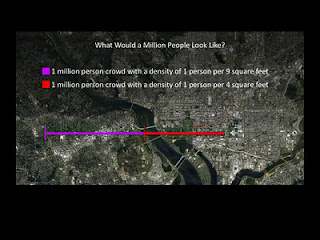
Airphotoslive.com graphic
At the left is Curt's graphic showing how the Mall would have to  
s-t-r-e-t-c-h into Virginia to accommodate one million people.   

Even allowing only 4 square feet for each person (that’s a spot only two feet by two feet), the Mall would have to stretch across the Potomac River into Rosslyn to make room for one million people.

Crowd estimates have been political tools for years:  the “anti” people had 300,000 people on the Mall; the “pro” mustered 400,000.  But these new estimates are much closer to reality in terms of real numbers.

They provide a look at how many showed up, but they don’t include those who couldn’t make it, but support the cause, and they do include those who just came down to the Mall to be part of a “happening,” and have no idea of what is really going on.

Thanks to people like Curt, we are finally getting credible, scientifically-based estimates on the size of Mall crowds - facts that may finally begin to limit the bickering about “how many.”  Measuring what the people in the crowds are thinking, why they’re really there, or why they aren’t there are different stories.  That’s for the politicians and media pundits to tell us.


Thursday, November 11, 2010

Demos - Gadgets are Fine, Content is Better

There is nothing as great as a demonstration that goes well, and nothing as embarrassing as a demonstration that flops.  I’ll leave out names, but a couple of special “moments” pop up during my tenure as the “digital edge” guy on NBC4, Washington.  

One demo was of a digital picture frame.  It was actually kind of cool.  The frame had an IP address, meaning it could be updated remotely.  The head of the company said he could send a picture of his kid playing soccer to a digital picture frame at the grandparents in Korea.  Did he have a picture of his kid playing soccer, or a quickly updating frame?   No.  The demo was lame, and could have been great.

In the early days of cell phone wars, demos were all the rage.  We were way beyond the 3-watt analog bag phone days and were going digital.  It seems like a new model of phone was coming out every month.  Sprint and Verizon were very media savvy and were always pushing to do a demo of the latest phones and what they could do. (emphasis on could).

The problem for Sprint was that their “PCS” sites were smaller in radius than “cells,” so they needed more site to cover the same area.  The nearest Sprint site wasn’t all that close to my station – so demos had a tendency to run on the slow side - if at all.  They eventually were able to locate a site a bit closer.  

Longtime followers of wireless networks will remember that Verizon’s mantra early on was “it’s all about the network” and “can you hear me now?”  There is still some of that same flavor with the “map wars” between Verizon and AT&T that grace a lot of TV screens.  But the emphasis has shifted to “what can you do” and what cool phone can you use to do it, how many apps are out there – the speed of the network so that live video looks really good.  

Yes, coverage is still an issue, but I don’t think it’s #1.  And it used to be the wireless companies were the big dogs carefully selecting which phones and which applications would be allowed to run on their networks.  Wow, what a switch.   Now they get told by the bigger dogs - the entertainment companies that used to be computer companies. 

I remember a conversation with a Sprint media representative, who said 15 years ago that we would be looking at our mobile phones more than talking into them.  He was so right.  I think many people pull out their phone/Blackberry/iPhone to check email even when they know there's nothing new.  The seems many people only use their phones to make calls when they "drive." It’s what we do.

Sit down for a moment and watch people come and go.  Most of them are looking at their phones, checking email, updating Facebook, tweeting, checking in using Foursquare, or even watching a movie. It’s either an addiction or another ploy not to make eye contact with the people around them.  (Better to connect with people far away from them – and update their status for the benefit of their tribe, group or network).   
Say “hello” to someone on the street and they’ll recoil. Try to “friend” them on Facebook and they’ll accept.  Hmmmm.  

Back to the demos.  Had a PR guy say he had pictures/videos of his client on his iPad.  It’s great to sport an iPad – it’s a perfect platform to show prospective clients/buyers a picture or video to close the deal.  This guy had the iPad – cool – but couldn’t find the pictures.  While devices are cool, content is still king.  At least that’s my take.

Always check your demo to be sure the content is there and easily findable. 

Monday, November 8, 2010

I Have a Code - in Two Places

Sometimes not trusting your instincts is difficult, and often can cost you a lot of time.
Case in point:  I changed the battery in my wife’s car.  Some of you may have experienced the same problem I encountered.  After the radio is disconnected from the battery, the anti-theft system kicks in and decides, “Help, I’ve been stolen.  You can’t use the radio, Nah, Nah, Nah, Nah, Nah, Nah” (performed by a chorus of taunting voices) ---- unless -----you have the Code-code-code (echo for effect).

My wife called with the bad news at mid-morning.  She wasn’t pleased.  We both listen to books on CDs as we travel and the radio wasn’t doing anything except displaying the time. Sigh!  No good deed goes unpunished.  This is what I get for replacing a failing battery with a new one.  Who knew?

I’m a semi-tech guy, so what’s the first thing I do?  Go online to see how others have handled this problem.  Right away, I found a site with an explanation of what was going on and different locations on the car that might give me a clue as to the correct code to enter so the radio would work again.

Let’s see - under the fuse box, under the coin tray, in the glove box, in the trunk.  And if that didn’t work, just turn off the radio, hold preset buttons 1 and 6, turn the radio on, and the serial number might pop up, call Honda, fax in the VIN#, a copy of your DL, serial number and they would call with the code within 48 hours.

In the back of my mind, I remember some notes from the previous owner (yeah, I buy used) that I may have filed away with the car’s maintenance records.  Was there something about a code for the radio?  Maybe.

When I got home from work, I proceeded to do a quick scan of the "code" locations on the car.  Plenty of stickers and numbers everywhere – a lot more than I suspected.  I tried a few of the numbers I found – didn’t work.  Maybe it was the fact that the preset buttons used to enter the code ran from 1-6 and some of the digits I wanted to enter were larger.  Pretty soon I'm thinking I'm looking at the wrong numbers.  And each time I enter a bad code, I come closer to the dreaded LOCKOUT (for an hour) Hmmmmm?  Fear not, this story has a semi-happy ending.

I found the correct code in two places.  The last place I looked because of my online search (the trunk), and in my notes from the previous owner, which in addition to the actual code, listed the places I could find it myself, just like the suggestions online.

Lesson:   I should have trusted my instincts and gone right to the folder in the file cabinet.  But solving the problem online was soooo much better because – because  -  or maybe it wasn’t.  The online search told me where to look.   The notes in my folder told me the actual code.   

Next time.....

Thursday, November 4, 2010

Connected - not social media, just family

This is not about technology – this is strictly personal.

Sometimes a road trip can have both unintended and intended consequences.  That happened to me recently when I flew back to the area where I grew up.  It’s almost difficult to describe that area.  I was raised in Mound City, IL but the area is not really “state” sensitive; it’s more of a region of crossroads, towns and small cities along the Ohio and Mississippi rivers. 

When I was growing up, it was nothing to drive 30 miles to see a movie or go to a “fancy” restaurant, or visit an amusement park.  Although I grew up in Southern Illinois, I played for a Paducah, Kentucky American Legion baseball team.  The area was (and still is) known as the “heartland.”  It’s home to great bar-b-que, barge terminals for the loading of grain, Southern Illinois University, a lot of farms, apple and peach orchards, corn for Ethanol, a riverboat casino and a hundred other things.

I try to go home at least once a year. It’s not enough, but life gets complicated.  This time, my daughter decided to take time away from her family and join me.  She hadn’t seen my parents in four or five years.  We flew into Memphis from our respective homes, rented a car and headed north --- and we talked and told stories.  My GPS said we were three hours from our destination.   

As lunchtime approached, we started seeing signs for Lambert’s, the home of “throwed rolls.”  
 

Before you click away, this restaurant, near Sikeston, Missouri  features, “throwed rolls.”   This place has been part of the folklore I’ve heard for a long, long time.  The story goes that every so often, a guy comes out of the kitchen with freshly baked rolls and shouts, “Who needs a roll?”  The hands go up – and the rolls get thrown – from five feet to 40 feet away.  And most people catch them. 
 
We had to see this for ourselves, so we stopped.  It was amazing.  People wanted to catch rolls whether they really wanted/need another roll.  The rolls themselves were pretty good, thrown or not. The menu included items like chicken fried steak, chicken and dumplings and a lot of foods that might not be on your cardiologist’s list of “healthy” foods.  It was tasty, although a little too much salt.  And no ---- there was no room for dessert.  Luckily, we ordered before people from three tour buses filled the place.  The stop was a good call and a great experience.

The intended consequence of the visit was for my daughter to visit with my parents.  Those of you with more life experience know that people often care more about their grandchildren than their children.  This was a good time for my daughter to really catch up with my Mom and Dad.  People change with time.  Trite, but true.  My little girl is now a Mom herself with two little boys; my parents are much older since the last time she saw them.  Both see each other with new eyes.

The unintended consequence of the visit is that I get to spend more time with my daughter talking about anything and everything.  We visit downtown Cape Girardeau, Missouri which is much different than it was in my childhood. There is a relatively new bridge across the Mississippi joining Illinois and Missouri.    


We stop for a few minutes along the riverfront to watch a tug push barges upriver.  It is a slow, steady process – a lot like life. 


Between visits with my parents, my daughter and I spend time at a nearby Starbucks, watch people and talk about EVERYTHING.  Not the conversations you have over the phone.  Not the conversations at Thanksgiving or Christmas with family lurking everywhere.  It was just us.  We talk on the ride back to Memphis to catch our flights.  We watch football together at the airport while we wait to board, and then leave to return to our separate, but always connected lives.

Tuesday, November 2, 2010

Pulp Fiction: Still a Lot of Paper Despite All Those Pixels.

Pulp Fiction –

No, not the famous movie directed by Quentin Tarantino.  It’s the fiction about all the pulp we would save by going digital.  I don’t know about you, but digital has saved me from “printing” a lot of pictures.  I still crank out a few every month, but they’re the best of the best that I want to share with people who don’t have access to computers or smart phones.  As for things that you read, the digital onslaught has cut down on some paper (or newspapers), but many of us feel we need a “hard copy.”
I’ll bet there’s someone in your office that seems to print out every email, every article, and every single thing that comes in digitally.  Sometimes the person doesn’t even bother to pick up what’s been printed, or forgets they printed it and prints it again. 


A few catalogs
And now that we’re in the Christmas Season (it starts shortly after Labor Day), the paper catalogs are really piling up.  The first little burp of catalogs started burdening the letter carriers in early October, and the buildup has been impressive.  I saved three week’s worth of catalogs just to see the stack (see photo).  Today, another dozen catalogs graced my mailbox.  I’m betting the USPS keeps track of this because it’s probably a substantial part of their business.  The weight of all these catalogs – presuming a lot of people receive them – must severely impact the gas mileage of their trucks and planes, as well as increase sorting time.

I started thinking about the companies that use paper catalogs.  Is there something special they think happens when a consumer has a physical catalog that doesn’t happen as easily on a website?  Do people at least look at the cover of each catalog before they toss it?  Does something catch their eye that causes them to leaf through it?  Would potential buyers even know that some of these products existed without the catalog staring them in the face?  I came across a set of goblets featuring the quote, “Friends Don’t Let Friends Drink Friends” (vampire motif).  What percent of catalogs are tied to an online presence?  What percent of people go to the website to order the perfect gift rather than use the order form in the catalog?  What’s your experience?

I’m also betting the paper catalog folks get enough takers to make it worth their while, or they wouldn’t keep sending them.  Whoaa! I’ve just found a "drum pen" for $7.95.  It says I can jazz up meetings by tapping a beat anywhere.  It offers snare, tom-tom and cymbal sounds.  It’s a pen….and a drum!! 

You know, I probably wouldn’t have stumbled upon that gift online.  Thank goodness for the catalog.